
Master Class 2026: Differential Geometry and General Relativity
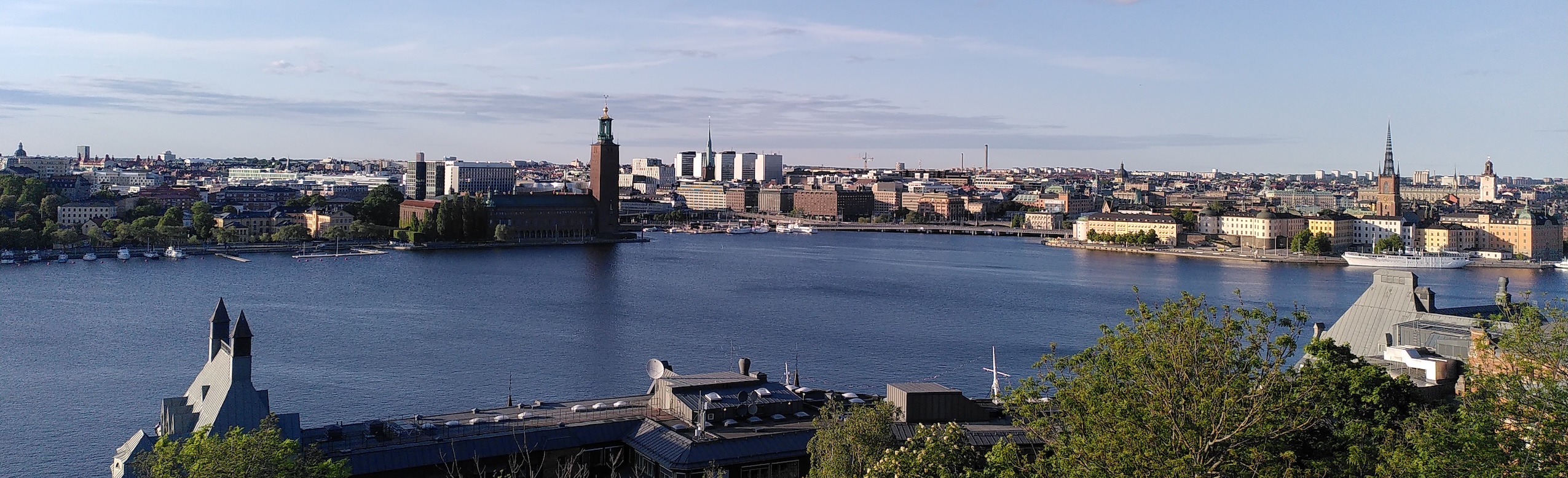
We are happy to be able to welcome all interested researchers, with particular emphasis on PhD students and postdocs, to this Master Class on Differential Geometry and General Relativity in Stockholm in May 2026! It is organized jointly between KTH Royal Institute of Technology and Stockholm University. The master class will take place during one week and consist of three mini-courses with the goal of taking the audience to the frontiers of development in some active and fascinating research areas in Riemannian geometry and mathematical general relativity.
Dates. May 18-22, 2026
Place. The lectures will be given in room
D2
in the main building at KTH.
Mini-courses. The Master Class will consist of the following three mini-courses:
- Lars Andersson (University of Potsdam): Gravitational instantons, history and recent developments.
- Christian Bär (University of Potsdam): Scalar curvature and the Dirac operator.
- András Vasy (Stanford University): The black hole stability problem: microlocal analysis and general relativity.
Registration. There are still some open places for the Master Class. If you want to attend please send us an email before May 10. (In the mail, please state your name and affiliation. Do you want to attend the dinner? Do you have any dietary restrictions?)
Financial support. Please note that we are not able to provide financial support for the participants.
Master Class dinner. The dinner will be on Tuesday evening at 6pm at Bistro Kevinge .
Hotel recommendations. Note that Stockholm is a fairly expensive city. Below, we listed some reasonably priced hotels that are not too far from KTH:
-
Ibis Styles Stockholm Odenplan
-
Best Western Hotel at 108
-
Scandic Go, Upplandsgatan 4
-
Scandic Go, Sankt Eriksgatan 20
Organizers. Mattias Dahl (KTH), Klaus Kröncke (KTH), Oliver Petersen (SU)
Contact. If you have any questions, please contact the organizers through dg-gr26@math-stockholm.se .
Poster. A poster for the masterclass can be found here: POSTER (pdf 1,2 MB) .
Abstracts.
Lars Andersson: Gravitational instantons, history and recent developments.
Gravitational instantons are complete, Riemannian, Ricci-flat four-manifolds with square-integrable curvature. Classical examples include the Riemannian Kerr instanton, and the Taub-NUT space. In these lectures, I will introduce needed concepts from Riemannian geometry and geometric analysis, and discuss relevant features of four-manifolds. I will explain known examples and classification results for gravitational instantons, and discuss some open problems and conjectures. Gravitational instantons with toric symmetry is an interesting special case, where the condition of vanishing Ricci curvature implies that inverse scattering techniques can be applied.
Christian Bär: Scalar curvature and the Dirac operator.
After a short introduction to spin geometry, I will use spinorial methods to investigate manifolds whose scalar curvature satisfies certain positivity conditions. Scalar curvature contains much less information than sectional or Ricci curvature which is why relatively sophisticated methods are needed to understand its implications. The results to be covered include Geroch’s conjecture on the impossibility of positive scalar curvature on tori as well as Llarull’s famous scalar curvature rigidity theorem.
Andras Vasy: The black hole stability problem: microlocal analysis and general relativity.
In the first lecture I will explain the black hole stability problem in classical general relativity and some of the recent results on it — these involve a fascinating combination of geometry and the analysis of partial differential equations. I will also give at least some indication of some of the tools that went into proving this. I will concentrate on the positive cosmological constant case (Kerr-de Sitter spacetimes), though I will also mention aspects of the vanishing cosmological constant case (Kerr).
In the next lectures I will briefly develop the microlocal, or phase space based, tools that allow one to analyze wave-type equations globally in the spacetime. I will then indicate how these can be used to handle the nonlinear geometric problem.
Finally, I will discuss the stability of the expanding (cosmological) region of Kerr-de Sitter spacetimes. I will also discuss the smoothness of the metric up to the future conformal boundary, with a Fefferman–Graham type asymptotic expansion, which is already of interest in de Sitter spaces, for which the global stability theorem of Friedrich in the 1980s was the first general stability result!
These talks are based on joint works with Dietrich Haefner, Peter Hintz and Oliver Petersen.
Schedule. All lectures take place in room D2 in the main building at KTH.
| Monday | |
|---|---|
|
09:15–09:30 |
Welcome |
|
09:30–10:30 |
Bär, Lecture 1 |
|
10:30–11:15 |
Break |
|
11:15–12:15 |
Andersson, Lecture 1 |
|
12:15–14:15 |
Lunch |
|
14:15–15:15 |
Vasy, Lecture 1 |
|
15:15–16:00 |
Break |
|
16:00–17:00 |
Bär, Lecture 2 |
| Tuesday | |
|---|---|
|
09:30–10:30 |
Andersson, Lecture 2 |
|
10:30–11:15 |
Break |
|
11:15–12:15 |
Vasy, Lecture 2 |
|
12:15–14:15 |
Lunch |
|
14:15–15:15 |
Bär, Lecture 3 |
|
15:15–16:00 |
Break |
|
16:00–17:00 |
Vasy, Lecture 3 |
|
18:00- |
Conference Dinner |
| Wednesday | |
|---|---|
|
09:30–10:30 |
Andersson, Lecture 3 |
|
10:30–11:15 |
Break |
|
11:15–12:15 |
Bär, Lecture 4 |
|
12:15– |
Lunch - Free afternoon |
| Thursday | |
|---|---|
|
09:30–10:30 |
Andersson, Lecture 4 |
|
10:30–11:15 |
Break |
|
11:15–12:15 |
Vasy, Lecture 4 |
|
12:15–14:15 |
Lunch |
|
14:15–15:15 |
Bär, Lecture 5 |
|
15:15–16:00 |
Break |
|
16:00–17:00 |
Discussion |
| Friday | |
|---|---|
|
09:30–10:30 |
Andersson, Lecture 5 |
|
10:30–11:15 |
Break |
|
11:15–12:15 |
Vasy, Lecture 5 |
|
12:15– |
Lunch - Free afternoon |